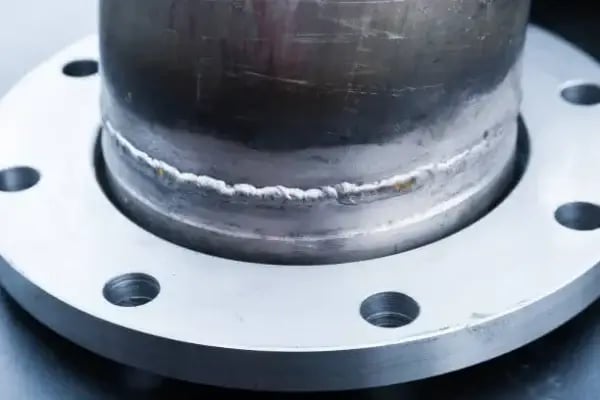
DIN vs ANSI Flanges: A Comparison of Metric and Imperial Standards
A comparison of metric and imperial standards.
11/7/20254 min read
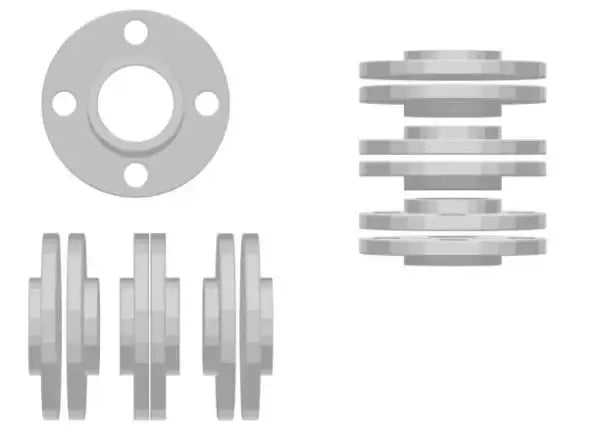
In the world of piping systems, the choice of flange standards is a critical decision that affects system compatibility, safety, and performance. This is especially important in international projects where components from different regions must connect seamlessly. Among the most commonly used standards are DIN vs ANSI flanges, which represent the predominant metric and imperial systems, respectively. Understanding these standards is essential for engineers, procurement specialists, and project managers who work with global piping infrastructure.
ANSI standards, originating from North America, dominate in the United States, Canada, and many Latin American countries, while DIN standards—developed in Germany—are widely adopted across Europe and parts of Asia. This article explores the key differences between these two flange systems, their applications, and how to choose the right standard for your project. This comprehensive DIN vs ANSI Flanges: A Comparison of Metric and Imperial Standards will guide you through the important considerations for successful flange selection.
What Are ANSI Flanges?
ANSI flanges are standardized by the American National Standards Institute, primarily following the guidelines set forth in ASME B16.5 and B16.47. These flanges use imperial measurements, with dimensions in inches. Commonly usedutilized in North America and Latin America, ANSI flanges are designed to meet various pressure classes, including 150, 300, 600, 900, 1500, and 2500.
ANSI flanges are valued for their robustness in high-pressure environments likesuch as oil and gas, petrochemical plants, and power generation facilities. Their design specifications include particular dimensions for bolt holes, flange thickness, and diameter, ensuring uniformity within the imperial system.
What Are DIN Flanges?
DIN flanges are developed by the Deutsches Institut für Normung, Germany’s official standards organization. These flanges conform to metric measurements, with dimensions in millimeters. DIN standards encompass various pressure designations such as PN6, PN10, PN16, PN25, and PN40, representing different pressure ratings.
Common DIN standards include DIN 2633 and DIN 2573 which define flange dimensions, materials, and pressure capabilities. DIN flanges are widely used across Europe and parts of Asia, particularly in manufacturing sectors such as food processing, water treatment, and chemical industries.
DIN vs ANSI: Key Differences
Measurement System
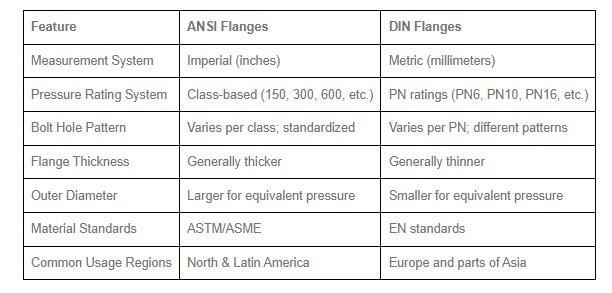
One of the most obvious differences between DIN and ANSI flanges lies in the measurement system. ANSI flanges use inches, adhering to the imperial system, whereas DIN flanges are based on metric units.
This fundamental distinction impacts every aspect of flange design and compatibility, making direct interchangeability problematic.
Pressure Ratings
ANSI flanges employ a class-based pressure rating system, where classes such as 150, 300, or 600 indicate the maximum allowable pressure. DIN flanges use PN (Pressure Nominal) ratings, like PN16 or PN25, which roughly correspond to ANSI classes but are not exact equivalents. For example, PN16 approximates ANSI Class 150 but differs in exact pressure limits and design factors.
Bolt Hole Pattern & Diameter
The bolt hole pattern is a critical factor in flange compatibility. ANSI and DIN flanges differ significantly in bolt circle diameter (BCD), the number of bolt holes, and hole size. This difference means flanges from one standard generally cannot be bolted directly to the other without adapters or custom solutions.
Flange Thickness and Outer Diameter
Another significant distinction is in flange thickness and outer diameter. Generally, DIN flanges tend to be thinner than their ANSI counterparts for similar pressure ratings. The dimensional variations between the two standards are substantial enough that attempting to mate DIN and ANSI flanges directly may lead to leaks or mechanical stress.
Material Specifications
ANSI flanges follow material specifications such as ASTM and ASME standards, including grades like A105 and A350. Conversely, DIN flanges use European norms, such as P235GH or stainless steel grade 1.4301. These material differences reflect regional metallurgical standards and can affect flange selection based on corrosion resistance, temperature rating, and mechanical strength.
Comparison Table: DIN vs ANSI Flanges
Can You Interchange ANSI and DIN Flanges?
Due to the significant difference between DIN and ANSI flanges in dimensions and bolt patterns, these flanges are not directly interchangeable. Attempting to connect DIN flanges with ANSI flanges without proper adapters or custom flange solutions can result in misalignment, leakage, or even safety hazards.
In systems where both flange types coexist, specialized adapters or transition flanges are required to ensure proper fit and pressure containment.
How to Choose Between DIN and ANSI Flanges
Choosing the appropriate flange standard depends largely on the project location, client specifications, and the existing piping infrastructure. Projects based in Europe or involving European-manufactured equipment typically specify DIN flanges to maintain system integrity.
Conversely, projects in the U.S. or those that follow international standards based on North American norms tend to use ANSI flanges. In complex or global projects, it is common to employ custom transitions to bridge metric and imperial flange systems, ensuring operational reliability.
Applications by Industry and Region
DIN Flanges: Preferred in European manufacturing sectors, water treatment plants, and food-grade systems, where adherence to European standards and metric measurements is the norm.
ANSI Flanges: Predominantly used in the U.S. oil and gas industry, petrochemical plants, power generation, and refineries where robust ANSI flange dimensions meet demanding pressure and temperature requirements.
Many global projects require compatibility with both DIN and ANSI flange standards, which require careful planning and the use of custom solutions to ensure safety and compliance.
Conclusion
Understanding the difference between DIN and ANSI flanges is crucial for ensuring the proper selection and compatibility of piping components in international projects. While both standards serve the same fundamental purpose, their differences in measurement systems, pressure ratings, bolt patterns, and materials mean they cannot be interchanged directly.
Selecting the correct flange standard ensures system safety, compliance with regulations, and operational efficiency. Whether your project calls for DIN flange standards or ANSI flange dimensions, partnering with an expert supplier can help you navigate the complexities of global flange standards.
Need help navigating international flange standards? Contact Texas Flange for expert support and custom flange solutions tailored for your global applications. Explore our range of flange dimensions and weights or request custom flanges designed to meet your exact project requirements.